Scientist and Educator.
Hi, I’m Tim. I am a…
Please have a look at my CV here.
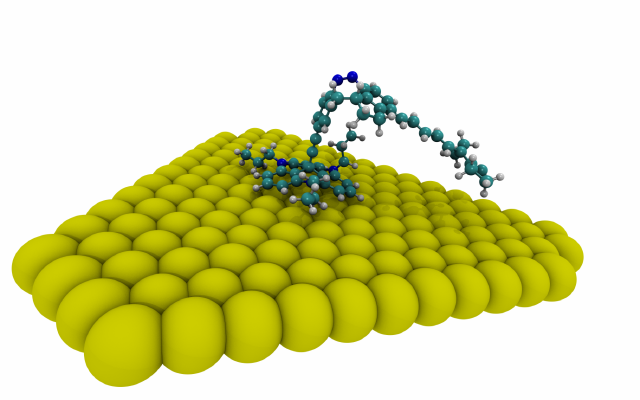
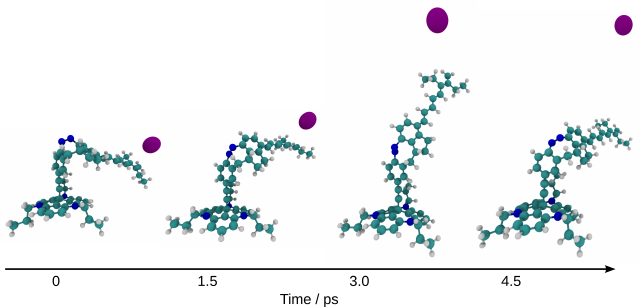
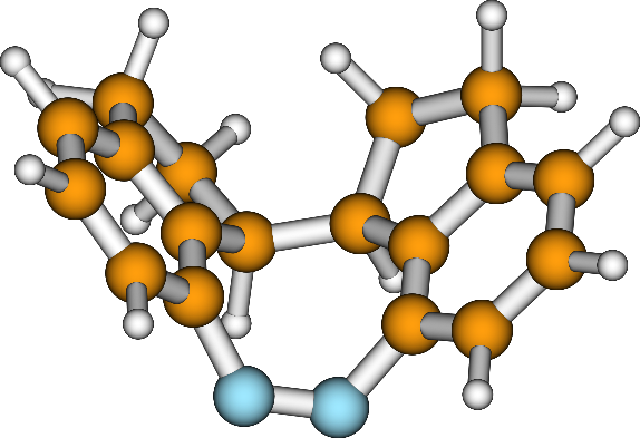
One main topic of my research was the photodynamics of azobenzene (AB) derivatives. AB is one of the workhorses of the CRC 677 and AB-based systems were extensively studied in Prof. Hartke’s workgroup by former members, since the discovery of a bridged AB derivative (brAB) in 2009. The popularity arose from the fact that for AB, a specifically optimized set of semiempirical parameters from Granucci and Persico was available, which allowed computationally low-cost calculations with high-quality results. With their expanded version of MOPAC, it was also possible to use this setup to perform surface-hopping MD calculations without much restriction regarding molecular size, when compared to other electronic structure methods. The MD simulations were able to replicate many experimental findings, illustrating the quality of the reparameterization. Based on this, further studies in this AB-field were performed by TR. The foundation of these works was laid by the QM/MM study on an artificial cilium. A cilium can be used for light-driven particle transport, so using AB as the photoactive motor unit seemed reasonable. Further synthetic advances from the organic chemistry workgroup of Prof. Herges at Kiel University led to a new generation of brAB derivatives. These new systems, indandiazocine (ID) and diindandiazocine (DID), restrict E → Z isomerization to only one direction, which was verified by direct surface-hopping MD calculations.
These new chromophores were then used in a new cilium project in two Bachelor theses: The first to update the cilia with the two new motor units and the second to use these new systems for actual particle transport and surface interaction simulations.
The second main topic of my research was excited-state intramolecular proton transfer (ESIPT).
The ESIPT-switch is a new project within CRC 677, bringing together organic, physical, and theoretical chemists. The primary aim of the theoretical part was to establish a computational setup that allows studying ESIPT processes by means of MD, with the long-term goal of predicting optimally designed new ESIPT systems for subsequent synthesis and analysis. Salicylic acid (SAc) and its derivatives are relatively simple systems, only showing proton transfer in the excited state, followed by relaxation to the ground state via a conical intersection. This behavior was already predicted by static calculations of SAc. In my thesis, I presented a publication on the first full-dimensional MD simulation of the ESIPT process of SAc.
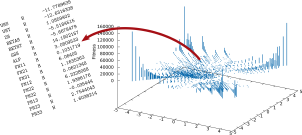
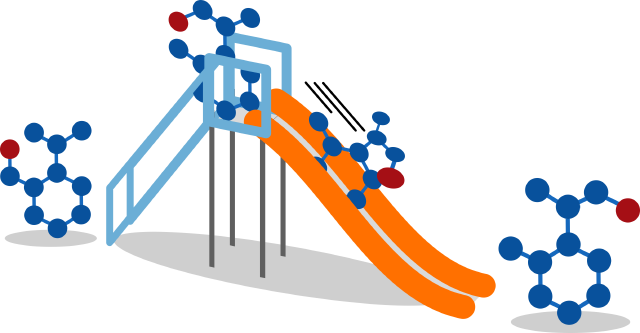
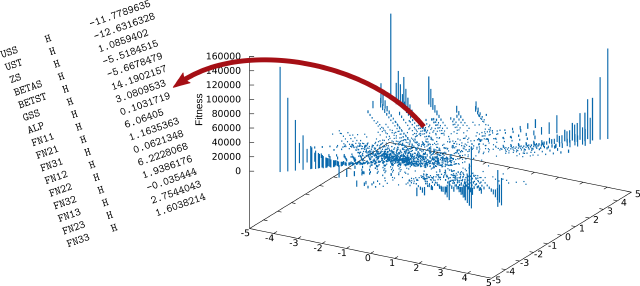
Due to the number of parameters and their interdependency, manual optimization and tuning of semiempirical quantum chemical method parameters is not feasible. For this, algorithms for such multi-dimensional problems need to be employed. In contrast to, e.g., geometry optimizations, the gradients of the parameter space are not known; therefore, only numerical optimizations can be used. Such methods do not require any prior information about the parameter space and can be used for virtually any optimization task. One example would be the simplex/simulated annealing (SIMPSA) algorithm, which was used for the azobenzene-specific parameter optimization.
In my thesis, I used a different type of method, namely particle swarm optimization (PSO). In PSO, as the name suggests, a swarm of individual particles is propagated on an n-dimensional surface to find its global minimum. The height of the surface is given by a function that evaluates the “fitness” of a particle at its coordinates on the surface. Since no information about the surface is available at the start of the propagation, no gradient can be followed towards a minimum. Therefore, the driving force of the particle is communication and memorization. A particle can remember its own position at the lowest height – best fitness – and can exchange this information with particles in the vicinity – the “neighborhood”. With this information – and some random perturbation – the particle will move along a vector that is the sum of the vectors towards its own best fitness and the best known fitness of the neighborhood.
Because PSO is a non-deterministic global optimization method, the chance of finding the “best solution” in a given problem space is never 100% within a finite number of iterations. Rigorously increasing the iteration number can help but is usually not an option: i) because of the computational cost per fitness evaluation (see below) and ii) because there is no guarantee that every iteration reaches points in the problem space that were never accessed before. Thus, covering the complete problem space is not feasible with non-deterministic methods. The only recourse is to start many optimization runs with varying initial conditions and observe whether they show a tendency to converge to the same solution. In contrast, deterministic optimization algorithms will always find the best possible solution but are only feasible for a small number of dimensions due to exponential scaling in computational effort.
The PSO as presented in my thesis was written in Perl, mainly because it is my preferred language for computer automation. However, any other programming or scripting language may be suited for PSO. This is because the computational demand of the algorithm itself is relatively low. The core of the PSO algorithm just performs some vector additions, so there is no need to employ an object-oriented or close-to-hardware-level language.

Science should not exclusively be about pushing the boundaries of knowledge. For me, it is equally important to help others reach the same level of understanding, according to the principle:
“We are all in the same boat.”
Novel ideas are good and important, but there will – inevitably – be a time when one has to step back – in whatever form – and then any unshared knowledge will be lost. Sharing knowledge is key for everyone to succeed and can come in many forms: documentation, consulting, teaching, …
Therefore, I am looking for like-minded people who are not solely focused on their own gain, but aim to serve others by bringing them together and encouraging the sharing of knowledge and ideas.