Azobenzenes

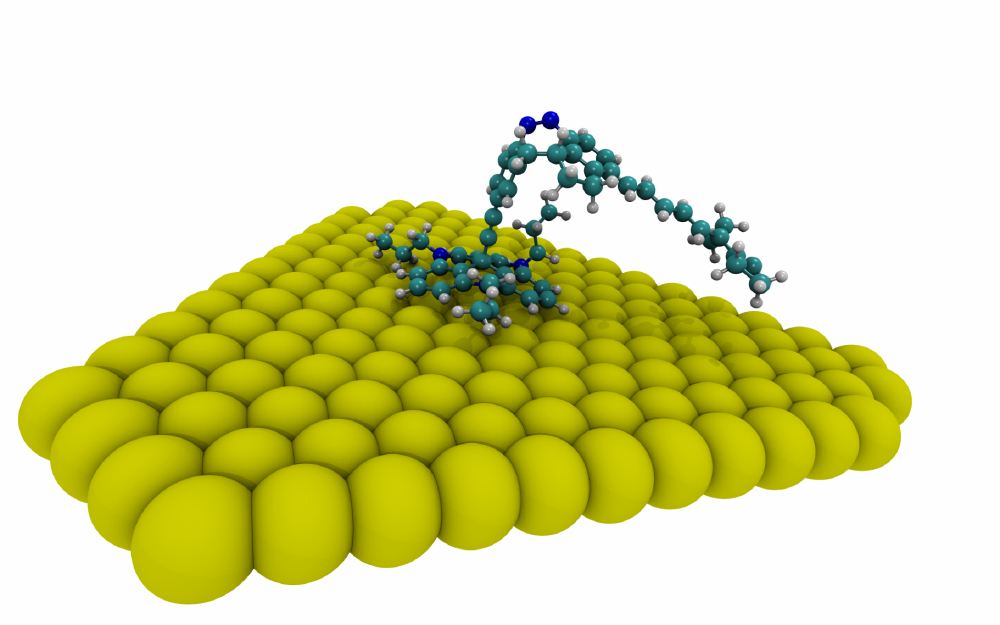


One main topic of my research was the photodynamics of azobenzene (AB) derivatives. AB is one of the workhorses of the CRC 677 and AB-based systems were extensively studied in Prof. Hartke’s workgroup by former members, since the discovery of a bridged AB derivative (brAB) in 2009. The popularity arose from the fact that for AB, a specifically optimized set of semiempirical parameters from Granucci and Persico was available, which allowed computationally low-cost calculations with high-quality results. With their expanded version of MOPAC, it was also possible to use this setup to perform surface-hopping MD calculations without much restriction regarding molecular size, when compared to other electronic structure methods. The MD simulations were able to replicate many experimental findings, illustrating the quality of the reparameterization. Based on this, further studies in this AB-field were performed by TR. The foundation of these works was laid by the QM/MM study on an artificial cilium. A cilium can be used for light-driven particle transport, so using AB as the photoactive motor unit seemed reasonable. Further synthetic advances from the organic chemistry workgroup of Prof. Herges at Kiel University led to a new generation of brAB derivatives. These new systems, indandiazocine (ID) and diindandiazocine (DID), restrict E → Z isomerization to only one direction, which was verified by direct surface-hopping MD calculations.
These new chromophores were then used in a new cilium project in two Bachelor theses: The first to update the cilia with the two new motor units and the second to use these new systems for actual particle transport and surface interaction simulations.